
Just for Fun: More Than Just A Funny Name – Fascinating Facts About The Planet Uranus
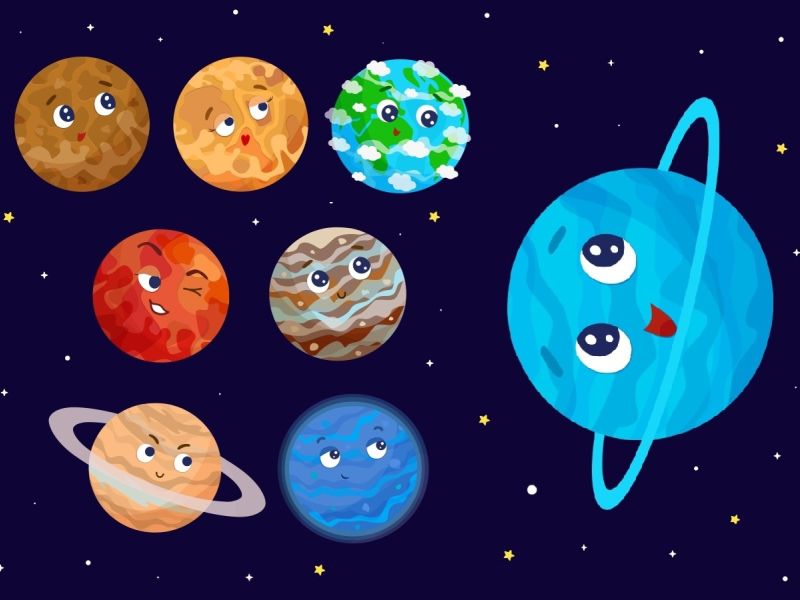
Today marks 245 years since William Herschel discovered the planet Uranus. To celebrate, we’ve picked our favourite facts about the planet – including how it got its (rather unfortunate) name. Plus, the story behind how Stikins® name labels were named.
Fascinating Facts About The Planet Uranus
The planet Uranus was officially discovered on 13th March 1781 by William Herschel from the garden of his home in Bath. To celebrate, we’ve picked our favourite facts about the planet and its discoverer. Did you know:
- Uranus is the third largest planet in our solar system with a diameter (at its equator) of 31,518 miles. That’s almost four times the diameter of Earth!
- Uranus is the coldest planet in our solar system with temperatures reaching -224°C. The lowest temperature recorded on Earth was -89.2°C.
- One year on Uranus (the time it takes to orbit the sun) is 84 years. One day on Uranus (the time it takes to rotate on its axis – the line from pole to pole) is 17 hours, 14 minutes, and 52 seconds.
- Unlike all the other planets (which rotate around a near vertical axis), Uranus rotates lying on its side.
- Thanks to its unusual axis tilt, Uranus has extreme summers and winters. For 21 years, one of its poles experiences permanent daylight, while the other experiences permanent darkness.
- Uranus is about 1.8 billion miles from the sun, which means it takes around 2 hours and 40 minutes for sunlight to reach the planet. It takes just 8 minutes and 20 seconds for sunlight to reach Earth.
- Uranus is between 1.6-1.96 billion miles from Earth (depending on their orbits). In a spacecraft travelling at 50,000 miles per hour, it would take 1,416 days (3.88 years) to reach Uranus.
- There are 29 moons known to orbit Uranus. All but 2 have names, which come from Shakespeare’s plays and a poem by Alexander Pope. All of Uranus’ moons are smaller than our moon.
- Uranus has 13 narrow rings; 9 main rings, 2 dusty rings, and 2 outer rings. They are all dark grey except for the outer rings – one is slightly red and one is blue. Uranus’ rings are much younger than the planet. The rings formed around 600 million years ago and Uranus around 4.6 billion years ago.
- Uranus was the first planet to be discovered for thousands of years and was the first to be classified using a telescope. Its discovery doubled the size of the known universe because Uranus is about twice as far from the sun as Saturn.
- The planet is visible to the naked eye but is extremely dim and slow moving. While earlier astronomers saw the planet, they kept misidentifying it as a star. Hipparchus’ 128 BC star catalogue describes a quadrilateral of four stars in the constellation Virgo. Only three of these stars exist and Uranus would have been in that position at that time. In 1690, John Flamsteed observed the planet at least six times but again miscatalogued it as a star.
- William Herschel wasn’t immune to errors either as he initially reported the planet as a comet.
- He discovered the planet using a homemade reflecting telescope. As a reward, King George III made Herschel the Court Astronomer with an annual stipend of £200 (around £30,000) – but only if Herschel moved closer to Windsor Castle so the Royal Family could use his telescopes!
- It took almost 70 years to agree on the new planet’s name. Following tradition, Herschel was asked to name his discovery. Unfortunately, few agreed with his choice of Georgium Sidus (George’s Star) in honour of King George III. In 1782, Johann Elert Bode suggested using the pattern established by Jupiter and Saturn. In Roman mythology, Saturn is father of Jupiter, so Bode suggested the new planet should be named after the father of Saturn. This should have been Caelus, Roman God of the Sky, but Bode accidentally used Uranus, the Latin name for Ouranos, Greek God of the Sky.
- The name Uranus was officially accepted worldwide in 1850. The first published joke about the name appeared 31 years later in satirical magazine Puck (although jokes circulated privately much earlier).
- William Herschel himself is an interesting figure:
- He learned how to make telescopes himself after being disappointed with those available to buy. This involved spending up to 16 hours a day grinding and polishing mirrors. He made over 400 telescopes and sold over 60 to other astronomers.
- Herschel built the largest scientific instrument of the time; a 40 foot (12m) reflecting telescope. It took five years to build and cost over £4,000.
- He discovered over 800 double or multiple star systems and over 2,400 “nebulae” (most of which are galaxies), along with two of Saturn’s moons and two of Uranus’ moons.
- Herschel also discovered infrared radiation and determined that coral was an animal and not a plant.
- Herschel played the oboe, violin, harpsichord, and organ. He wrote over 200 musical works, including 24 symphonies and 14 concertos.
- William Herschel was assisted in his astronomy work by his younger sister Caroline. She discovered 8 comets and updated Flamsteed’s 18th century star catalogue.
Why Are Stikins® Named Stikins®?
When choosing a name for our name labels, we wanted something simple that described our product and what they are designed to do. So, what are Stikins® designed to do? Simply put, they’re designed to stick!
We designed Stikins® to be modern name labels that would give busy parents a quick and effective way to label school uniform and kit. We wanted to help parents get away from sew-in tapes and iron-on tags and provide them with name labels that work fast – and effectively. The best solution to the problem was obvious – stick on name labels that simply stick on and stay on, with absolutely no need for sewing or ironing.
This meant we needed a name that reflected the sticky nature and stick on purpose of our name labels. We designed Stikins® to simply stick on and stay on – to stick in (or Stik-in), which led us to … Stikins®!
Since their naming, we’ve introduced new and improved name labels that all share the same aim and the same name – sticky name labels that parents can stick onto their children’s belongings knowing that they will stay stuck!
So, if you’d like to see just how sticky our stick on name labels really are, why not order a pack today. You can order online at anytime or order by phone during office hours (9am-5pm, Mon-Fri). We print and post all orders same day (order by 3pm, Mon-Fri) or next working day (order after 3pm or over the weekend). We post all orders by first class post and delivery is free!