
Just for Fun: Fascinating Facts About Our Feathered Friends For World Sparrow Day
Today is World Sparrow Day! We’re celebrating with some fascinating facts about our feathered friends. Plus, learn how Stikins® name labels keep your kids’ kit safe whenever they leave the nest.
Fascinating Facts About Feathered Friends To Get You Fluttering For World Sparrow Day
World Sparrow Day aims to raise awareness about the threats faced by house sparrows (and other common birds) in urban environments. House sparrows have lived alongside humans for thousands of years but their numbers have declined. Here are our favourite facts about house sparrows to celebrate our feathered friends. Did you know:
- House sparrows are found more widely than any other wild bird. They originated in the Middle East and spread naturally to most of Europe and Asia, along with North Africa. Thanks to intentional and accidental introductions elsewhere, they are now found on every continent except Antarctica.
- While their favourite places are human houses, they have followed us into some pretty unusual places. House sparrows have been found in warehouses and factories, in zoos, on ships, in a coal mine (2,100ft underground), and on the observation deck of the Empire State Building.
- While most house sparrows won’t move more than a few miles in their lifetime, some house sparrows from the UK have been tracked to France and Belgium.
- While most house sparrow live for about 3 years, the oldest wild house sparrow lived around 19 years and 9 months, while the oldest captive house sparrow lived for 23 years.
- House sparrows are about 14-15cm in length with a 21-25cm wingspan. Their short wings aren’t built for a lot of flying so they stick close to vegetation for cover. They can fly at speeds of up to 28.3mph or about 15 wingbeats per second. They tend to hop along the ground and can swim and dive (even swimming underwater) if necessary.
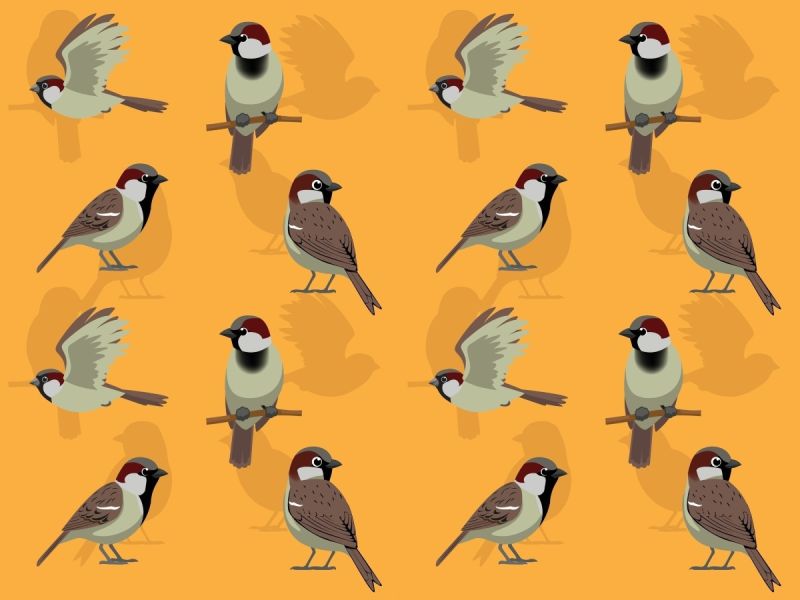
- Male and female house sparrows look different. Males have a chestnut brown back with black markings and are pale grey underneath. They have a white wing bar and a black bib. They have a chestnut brown head with a grey cap and cheeks. Females have a brown back with black markings and are grey or brown underneath. They have a pale double wing bar. They have a brown head with a brown cap and a cream stripe behind the eye. Young house sparrows look more like females but are paler above and darker underneath.
- Males will start building a nest and then call for a mate. They will then mate for life, usually having two clutches of eggs each year with four or five eggs per clutch. House sparrow eggs take just under two weeks to hatch. Both parents feed their young for two weeks until they are ready to leave the nest.
- A house sparrow’s nest has three layers; an outer layer of stems and roots, a middle layer of grass and leaves, and an inner layer of feathers and other soft materials (like paper).
- House sparrows usually nest in the eaves and crevices of houses but will also use natural crevices in cliffs, banks, and trees. In cities and towns, they sometimes build nests on street lights and neon signs to take advantage of the heat they generate.
- House sparrows are very social – and will even form flocks with other species of bird. They roost communally (often in trees or shrubs) and their breeding sites are usually grouped together. They also take part in social activities including water or dust bathing and singing.
- About 90% of a house sparrow’s diet is seeds. While they prefer cereals (like oats, wheat, or maize), they will eat the seeds of most grains, flowering plants, and weeds. They will also eat buds, berries, and fruits like grapes and cherries.
- House sparrows will happily eat food left out by humans, including waste and leftovers. They are quick learners and have been seen opening automatic doors of shops and supermarkets and clinging onto walls next to balconies.
- House swallows also eat to grit to help digest harder items; this comes from stone, masonry, egg shells, or snails.
- House sparrows eat flying insects such as flies and beetles, moths and butterflies, wasps and termites, and mosquitoes and gnats. Young house sparrows are fed mostly on insects, along with small quantities of seed and grit.
- The main predator of the house sparrow is the cat.
- Sparrow pie was a traditional dish in northern Europe from around 1560 to at least the 19th century!
- While the global population is over 1 billion individuals (making house sparrows one of the most populous wild birds), their numbers have declined all over the world.
- The UK population of house sparrows peaked in the early 1970s. Since then their numbers have fallen by about 68% overall and around 90% in some urban areas. In London, where house sparrows were once so common they were called “Cockney Sparrows”, it is estimated that three quarters of the population was lost between 1994 and 2000.
How Stikins® Keep Your Kids’ Kit Safe Away From The Nest
Stikins® make it really quick and easy to label all your children’s belongings. We make our stick on name labels with a unique adhesive that forms super strong bonds to hold your labels firmly in place. Simply peel each label off the backing sheet and apply firmly; your Stikins® will simply stick on and stay on. You can then put labelled items through the washing machine, tumble-dryer, dishwasher, and microwave – not to mention the rough and tumble of everyday life.
Name labels make it super easy to return lost items and remove all doubt about who owns what. So, if your kids lose something away from the safety of your nest, that item is easy to return. Stikins® are bright white labels printed with a bold black font to make them really clear and easy to read. You can personalise your name labels with one or two lines, with up to 18 characters per line (including spaces).
You can order Stikins® online at anytime or by phone during office hours (9am-5pm, Mon-Fri). We will despatch your order same day if you order by 3pm (Mon-Fri) and on the next working day if you order after 3pm or over the weekend. We use Royal Mail’s first class service as standard and delivery is free!
So, why delay? Order now and we’ll have your stick on name labels winging their way to your nest in a flutter!